Explain the Differences Between Situational Ethics and Relativism
Absolutism holds that standards are always true. Ethical relativism is the theory that holds that morality is relative to the norms of ones culture.
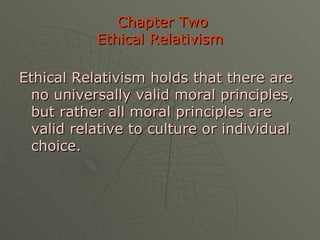
Chapter 2 Ethical Relativism
However relativism is based on social norms and is defined as would could be beneficial and good for some people.
. Ad_1 Class- Ethical issues in criminal justice. In situational ethics the principle says that the particular context of the situation has to be evaluated. Differences between situational ethics and relativism.
Your assignment must be one full page of 300 words or more and include references. Situational ethics or situation ethics takes into account only the particular context of an act when evaluating it ethically rather than judging it only according to absolute moral standardsWith the intent to have a fair basis for judgments or action one looks to personal ideals of what is appropriate to guide them rather than an unchanging universal code of conduct such as. Deontolgical and teleological may be unfamiliar words but the concepts that underlie them will be familiar to you.
Some governments around the world are in favor of the death penalty because through killing those criminals. These are two of the popular philosophical debates under ethics the study of morality. As anthropologist Ruth Benedict illustrates in.
Jul 02 2021 0639 AM. For the ethical relativist there are no universal moral standards --. This means that in situation ethics judging what is right and what is wrong mostly depends on the situation at hand.
Determine which ethical system s support the questions in Nashs How to Make an Ethical Decision. The Absolutist theory is the theory that certain things are right or wrong from an objective point of view and cannot change according to culture. It is not a fixed law.
This principle says that the universal law should be ignored and the low of love should be considered. Both absolutism and relativism are philosophical concepts on moral values. The basic types of ethical systems are deontological systems and teleoogical systems.
Ethical relativism denies universal moral principles claiming that moral codes are strictly subjective. Relativist moral theories may consider the consequences of moral actions when deciding if they are right or wrong. If from an objective point of view ones own values and the values of ones society have no special standing then an attitude of live and let live toward other peoples values seems appropriate.
Ethnocentrism involves looking at another culture from the perspective of ones own culture while cultural relativism involves looking at another culture by its own perspective instead of ones own culture. Explain the difference between absolutist and relativist ethics. Explain the differences between situational ethics and relativism in essay format.
The situation ethics considers flexible approaches in ethical related decisions in order to take case by case views to situations. Hence individuals under the situation ethics will use general moral principle while the ones taking the view of relativism will rely on the cultural or group rules hence rigorous set of ethical rule. Ethical Relativism is the theory that an ethical viewpoint can be specific to a given society.
Explain the differences between situational ethics and relativism. This is also known as deontological. On the other hand relativism is a position whereby all views are valid equally hence an individual has the right to determine what is true.
On the other hand relativism considers the contexts of situations. This is also known as deontological. Therefore whether an action is right can depend on the context such as culture in which it takes place.
Few universal truths different situations call for different responses. When I say that situational relativism may be correct for it is correct to do one thing in one culture but may. There are no absolute definitions of right or wrong.
Explain the differences between situational ethics and relativism. There are two different ways in distinguishing whether something is right or wrong within ethics. Morality is therefore relative to the norm of ones culture.
I have said in the previous article that only situational relativism or situational ethics may be correct but not cognitive and moral relativism. 11 years experience on custom writing. The main difference between ethnocentrism and cultural relativism is the way in which you evaluate or assess foreign culture.
The Absolutist theory is the theory that certain things are right or wrong from an objective point of view and cannot change according to culture. That is whether an action is right or wrong depends on the moral norms of the society in which it is practiced. The absolute moral or ethical standards should not be considered.
Explain how situational differences support ethical relativism. Whereas relativism is a teleological theory which determines whether an action is right or wrong based on the outcomes of the action on its consequences this is linked with situation. Ethical situationalism states moral principles are objective and should be applied.
Certain actions are intrinsically right or wrong which means they are right or wrong in themselves. In contrast moral relativism views moral values as entirely relative to different societies and contexts. The same action may be morally right in one society but be morally wrong in another.
Situational ethics accounts for the act in the moment before evaluating its moral standards. Explain the differences between situational ethics and relativism. Ethical relativism seems especially well suited to explain the virtue of tolerance.
The Differences Between Situational Ethics And Relativism In Essay Format. Hence absolutism endorses equality while relativism advocates equity. Let me explain further what I mean by that statement.
Key Difference Absolutism vs Relativism Absolutism and relativism are two concepts that are associated with many terms although there is a key difference between these two wordsAbsolutism approaches things in an objective manner. In particular this acknowledges that what may be considered the norm in one culture is out of the ordinary in another. Explain the difference between absolutist and relativist ethics.
So there are no universal guiding rules and regulations that govern the moral rules or rights. Relativism has no moral right and wrongs with no absolutes Pollok 2017. VIdeo explaining the difference between ethical relativism and absolutism.
Place your order now for a similar paper and have exceptional work written by our team of experts to guarantee you A Results. Some action can be right or wrong depending on situational factors. Certain actions are intrinsically right or wrong which means they are right or wrong in themselves.
Absolutism is a deontological theory which determines whether an action is intrinsically right or wrong. The situations and living worlds of different people vary so much that it is difficult to believe that the same things that would be right for one would be right for another.

Ethics Moral Relativism What Is Moral Relativism Moral Relativism States That There Are No Moral Absolutes A Moral Absolute Is A Moral Instruction Ppt Download
2
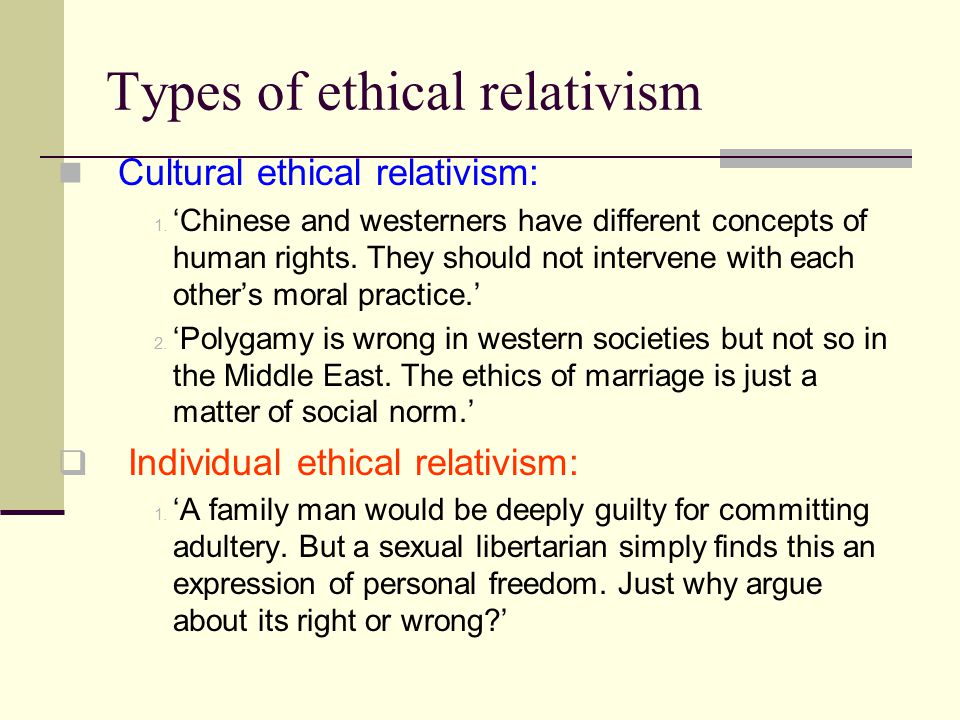
Ethical Pluralism And Relativism Ppt Download


Comments
Post a Comment